The Celeriac Doesn't Bite: Getting Past the Veg-Box Stare
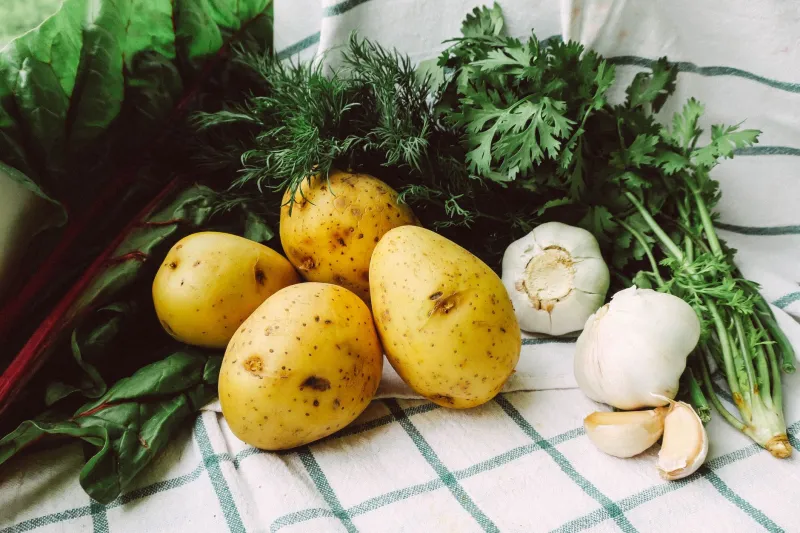
There's a particular look that comes over a person when a veg box lands on the kitchen table. It's not quite disappointment. It's more like being handed a small, muddy exam. The carrots and onions get dealt with easily enough. Then you get to the bottom of the box, and there it is: a celeriac the size of your head, a bunch of chard with stems like rhubarb, maybe a kohlrabi that looks like an alien satellite dish. You put it in the fridge. You take it out again on Thursday. You put it back. By Sunday it's in the bin and you feel mildly guilty about the money.
That cycle is the reason a certain kind of cookery class exists — the seasonal veg session, usually built around a farm box or a market haul rather than a neat recipe list. It's a small, practical fix, and it's worth understanding before you book one.
The staring is not a skill problem
Here's the thing worth saying plainly: if you can roast a potato, you already have the technical ability to cook a celeriac. You can peel things. You can turn on an oven and salt a tray. The obstacle isn't technique, it's recognition. You don't know how it behaves, so you don't know what to expect, so you stall.
Recipe apps don't help much either. They work backwards from a dish you've decided to make, which means you end up shopping for the recipe rather than cooking the food you already own. Celeriac sits in the fridge because it isn't in the plan. That's an organisational gap dressed up as a cooking gap.
What a hands-on session actually changes
Good seasonal classes work on recognition. You handle the thing, you smell it raw, you learn what it does when it hits heat. Within twenty minutes of a decent class you've usually learned three or four routes for the same vegetable, and — more importantly — the logic behind those routes, so you can apply it to something the tutor never mentioned.
The classes that do this well tend to be half-day sessions with a shared bench, six to twelve people, and a tutor who talks while chopping. You're not following a laminated sheet in silence. You're watching, asking daft questions and tasting things at each stage, including the disappointing ones.
Prep first: the routes almost every vegetable respects
Most of the panic comes from not knowing where to start. A good class will hammer home a handful of default approaches you can rotate:
- Raw and thinly sliced. Celeriac, kohlrabi, fennel and beetroot all respond to a mandoline or a sharp knife, a bit of salt and something acidic. Ten minutes, done.
- Roasted hot and hard. Cut into chunks roughly the same size, oil generously, season properly, give it space on the tray. This works for practically anything root-shaped.
- Braised or puréed. Celeriac, parsnip and squash all soften into something silky with stock, butter and time. This is the route that makes soup taste expensive.
- Stems treated as their own vegetable. Chard stems are not waste. Slice them, soften them in a pan with garlic and chilli, and they'll take on a texture closer to celery than spinach.
Once you've seen chard cooked three ways in an hour, the leaves stop being a mystery and start being an ingredient.
Flavour logic that travels with you
The other half of the lesson is pairing — and this is where classes genuinely beat videos, because you taste the difference side by side. Celeriac is earthy and slightly sweet; it wants mustard, lemon, hazelnut, thyme, a bit of cream, or something sharp like capers. Chard is faintly bitter; it wants fat and acid, so olive oil, garlic, a squeeze of lemon, a grating of nutmeg if you're feeling traditional.
Ask a tutor to explain why those pairings work and you'll start seeing the pattern: something sweet against something bitter, something fatty against something sharp. That's the transferable bit. It's what stops you buying a new cookbook every time an unfamiliar vegetable appears.
Waste-cutting habits that outlast the box
A decent chunk of a veg-box class is quietly about thrift, and that's no bad thing in a year when a weekly box costs real money. The habits tend to be simple ones you can adopt immediately:
- A freezer bag for trimmings — onion skins, carrot peel, chard stems, herb stalks — that becomes stock once it's full.
- Leaves, tops and peelings treated as ingredients where they make sense (celeriac peelings roasted in oil are genuinely good).
- A Sunday 'use it up' session where whatever's left gets roasted on one tray and turned into something.
None of these need a class to teach you. All of them are much easier to adopt once you've done them once with someone standing next to you.
How to pick the right class
A few things worth checking before you part with money:
- Is it veg-led or technique-led? You want a class that says it's about seasonal vegetables, knife work and adaptable methods — not one that happens to include celeriac in a menu.
- Will they let you bring your own box? Some community and farm-based classes do. That's a huge bonus — you leave knowing how to cook your problem ingredients.
- Is the group small? Twelve is fine. Twenty-five is a demonstration with extra steps.
- Does it cover storing and planning? A short chat about what keeps for a fortnight and what needs eating first saves you more money than any recipe.
- Will they say if you can swap things? Nobody should be forced to eat something they actively dislike. Confidence grows faster when the stakes are low.
Expect to pay somewhere between £60 and £120 for a half-day in most UK cities, less through a community kitchen or an adult education centre. Worth every penny if you're currently binning a quarter of your box each week.
The bit that happens afterwards
The class doesn't fix the box. What fixes the box is cooking one unfamiliar thing deliberately in the week after — the same way you did it at the bench, with the same prep and the same seasoning checks. Do that four or five times and the stare stops happening. You'll look at a celeriac and think 'purée, then, with mustard' rather than 'oh no'.
That's the modest promise of a seasonal veg class. Not a transformed kitchen, just one fewer thing going in the bin and one more dinner you didn't have to plan in advance.